Most luxury skincare was never engineered to work. That is not a marketing line. It is the uncomfortable truth that Sabina Kelley, founder of Truffelle, arrived at after spending years and serious money on prestige products that delivered nothing beyond a temporary, surface-level glow. If you are a woman over 50 in Australia and you have felt that same quiet frustration, the one where you can recite the ingredients on six different serums and still see no structural change in your skin, the problem is not you. The problem is molecular.
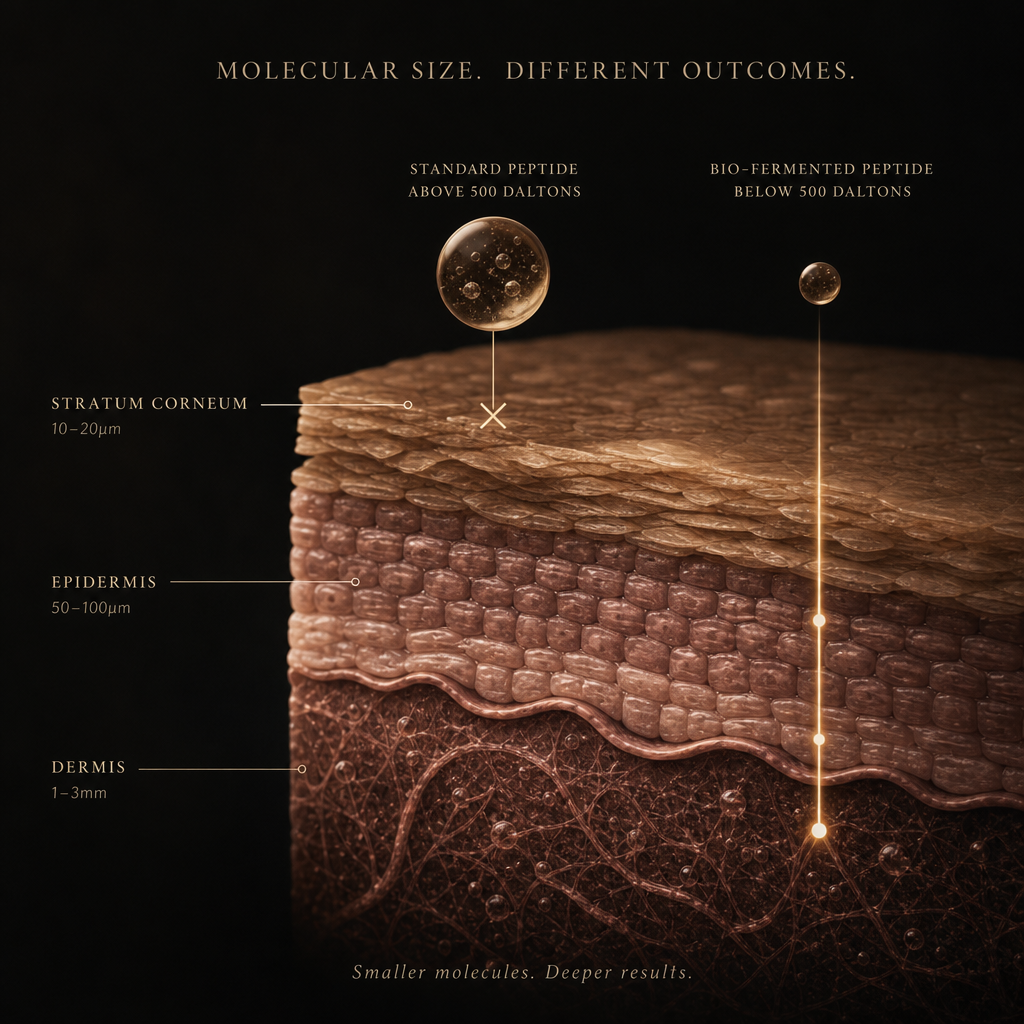
The prestige skincare industry is built on beautiful packaging, aspirational marketing, and genuinely high-quality base ingredients. What it is not built on, in most cases, is a delivery system capable of getting actives past the skin's barrier and into the dermis where collagen synthesis, lipid matrix repair, and structural renewal actually occur. Standard peptide molecules sit above the 500 Dalton threshold, the molecular gateway to the dermis. Below that threshold, actives penetrate. Above it, they hydrate the stratum corneum and go no further. That is why surface solutions dominate the market: they feel good, they look good on a shelf, and they never quite close the gap between promise and result.
This article is for the woman who knows the difference. It explains the science behind why so many premium formulations underdeliver, walks through the hidden trade-offs in mainstream actives like retinol and synthetic vitamin C, and makes the case for why bio-fermented truffle peptides, specifically Truffelle's world-first technology, represent a genuinely different approach to anti-ageing skincare that penetrates the skin barrier and repairs what sits beneath.
Key Takeaways
- Most luxury skincare peptides are too large to cross the skin barrier, so they hydrate the surface without reaching the dermis where structural repair happens.
- The 500 Dalton rule is the defining threshold: actives below it penetrate, actives above it do not.
- Common mainstream actives including retinol and AHAs carry real drawbacks including photosensitivity and, in many formulations, the presence of synthetic compounds and endocrine disruptors.
- Truffelle's bio-fermentation process reduces Barossa Valley Black Truffle compounds below 500 Daltons, enabling sub-500 Dalton penetration to the dermis.
- Clinical data referenced by Truffelle shows results of +48% hydration, +35% skin elasticity, +30% collagen production, and a 12.8% reduction in wrinkle depth over 42 days.
- Fewer, better actives delivered where repair happens outperform a complex multi-step routine built on surface-level products.
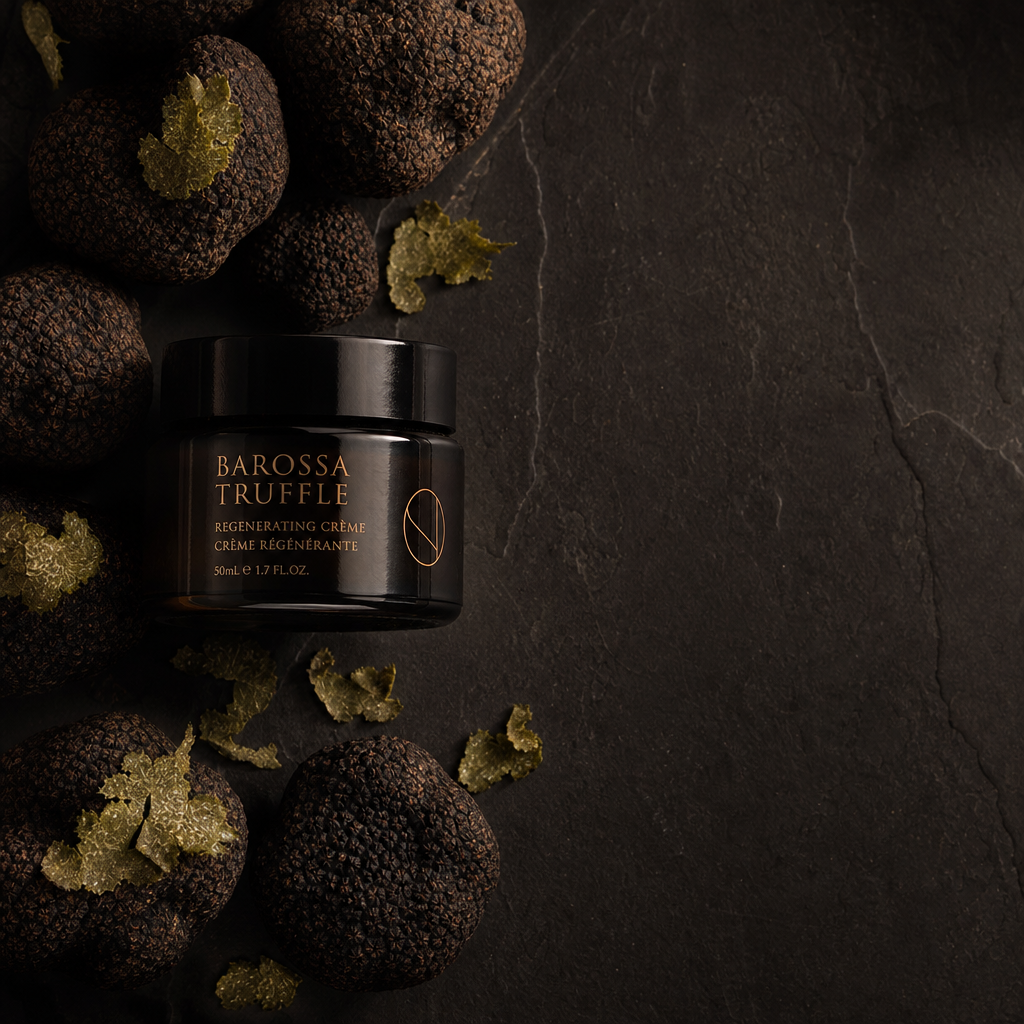
Our hero pairing. Clinically formulated for visible renewal, daily.
Summary Table
| Feature | Mainstream Luxury Skincare | Truffelle Bio-Fermented Formulations |
|---|---|---|
| Molecular size of actives | Above 500 Daltons in most cases | Reduced below 500 Daltons via 90-day fermentation |
| Dermal penetration | Limited; hydrates stratum corneum | Confirmed sub-500 Dalton penetration to the dermis |
| Key active mechanism | Standard peptides, retinoids, AHAs | Bio-fermented Black Truffle peptides and metabolites |
| Photosensitivity risk | Moderate to high (retinol, AHAs) | Zero photosensitivity |
| Endocrine disruptor risk | Present in many mainstream formulas | Zero endocrine disruptors |
| Clinical result (hydration) | Variable, often surface only | +48% (Phenbiox / University of Bologna) |
| Clinical result (elasticity) | Variable | +35% (Phenbiox / University of Bologna) |
| Clinical result (wrinkle depth) | Variable | -12.8% over 42 days (Phenbiox / University of Bologna) |
| Batch production | Mass scale | Small seasonal batches, poured within 72 hours of fermentation |
| Sourcing | Global, variable provenance | Hand-harvested, Barossa Valley, South Australia |
The Problem No One in the Industry Wants to Say Out Loud
When Sabina Kelley entered her 40s, she was doing everything right by conventional standards. She had built a considered routine around prestige serums, expensive moisturisers, and the actives that every dermatologist and beauty editor endorsed. She followed the advice. She applied retinol at night, layered vitamin C in the morning, and used SPF religiously. The investment was significant. The results were not.
What she noticed was what millions of Australian women over 50 notice: the products felt good, and some even improved hydration temporarily, but the skin changes that came with menopause and the natural collagen decline of her age continued regardless. Fine lines deepened. Elasticity dropped. The structural quality of her skin kept shifting in a direction no cream seemed to slow.
This is not anecdotal disappointment. It reflects a biological reality that most brands do not advertise. After 50, the skin undergoes compounding structural changes. Collagen production declines significantly. The lipid matrix in the skin barrier becomes less efficient at retaining moisture, leading to transepidermal water loss. The dermis, the layer beneath the epidermis where the scaffolding of your skin lives, is receiving less support. To address those changes, actives need to reach the dermis. Most of them never do.
The 500 Dalton rule, documented in pharmaceutical dermatology literature, identifies the upper molecular weight limit for transdermal absorption. Molecules above 500 Daltons do not penetrate the stratum corneum in any clinically meaningful way. The majority of peptides used in premium skincare formulations sit well above that threshold. They moisturise the skin's outer layer, which is genuinely useful, but they cannot stimulate collagen synthesis, repair the lipid matrix, or rebuild the structural architecture of the dermis. Where other creams end, Truffelle begins.
The industry knows this. The 500 Dalton rule has been discussed in dermatological and pharmaceutical research for decades. Yet most luxury brands continue to build formulations around large-molecule peptides because they are stable, they photograph well in marketing imagery, and they produce immediate cosmetic effects that photograph well in the short term. The gap between what is marketed and what is mechanically possible is wide.
Why Retinol, AHAs, and Vitamin C Come With Real Trade-Offs
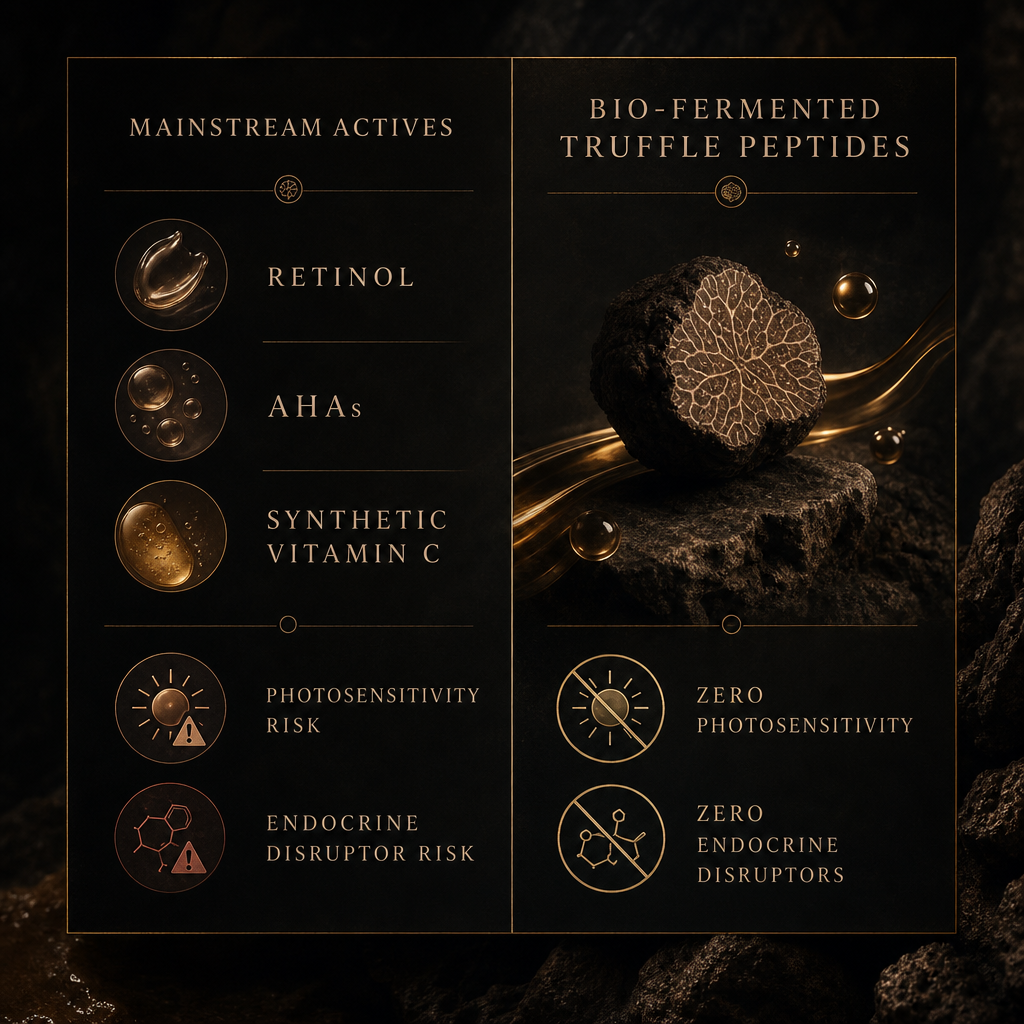
The conventional anti-ageing toolkit for women over 50 is well-rehearsed: retinol for cell turnover, AHAs for exfoliation, vitamin C for brightening and collagen support. These actives do have evidence behind them. But the conversation about their limitations is rarely had with the same confidence as the conversation about their benefits.
Retinol, including its prescription-strength derivative tretinoin, significantly increases photosensitivity. For women using retinol consistently in the Australian climate, where UV index readings regularly reach extreme levels across most capital cities, that photosensitivity is not a minor inconvenience. It is a real risk factor for accelerated UV damage, particularly in skin that is already experiencing the thinning and reduced barrier function that comes with age. The paradox is pointed: you are using an anti-ageing active that simultaneously increases your skin's vulnerability to the primary driver of photoageing.
AHAs carry a similar photosensitivity concern. They work by dissolving the bonds between dead skin cells at the surface, which improves texture and can support the appearance of brightness. But they are exfoliating an already-thinning barrier and require consistent, diligent sun protection to avoid the kind of UV damage that more than offsets any surface improvement.
The endocrine disruptor issue is less widely discussed and more contested, but it is real enough to warrant attention, particularly for women over 50 whose hormonal environment has already shifted significantly through perimenopause and menopause. Many mainstream skincare formulations contain parabens, certain UV filters, and synthetic fragrance compounds that have been identified in research as potential endocrine disruptors. Regulatory scrutiny of these compounds is active in Australia, with the Australian Industrial Chemicals Introduction Scheme (AICIS) continuing to assess the risk profile of several synthetic cosmetic ingredients. The prudent position for a woman navigating a changed hormonal landscape is to minimise unnecessary synthetic load.
None of this means that retinol and AHAs are without merit. But the honest framing is this: they are surface-active compounds with real trade-offs, and for women over 50 in Australia whose primary goal is structural skin repair rather than exfoliation, there is a better-engineered option available.
Truffelle's Answer: Bio-Fermented Truffle Peptides and the Master Key
Sabina Kelley did not arrive at bio-fermented Black Truffle peptides because truffles are luxurious. She arrived there because the science pointed her toward a specific solution to a specific problem: how do you reduce a complex bioactive compound to below 500 Daltons without degrading its efficacy?
The answer required growing Black Truffles herself. Not purchasing extracts through a supply chain, but cultivating Tuber melanosporum within a 35-million-year-old meteor crater in the Barossa Valley, South Australia. The mineral-rich soil of that formation produces truffles of exceptional biological complexity. Those truffles are hand-foraged at peak maturity, at the precise moment when their bioactive compound density is at its peak molecular zenith.
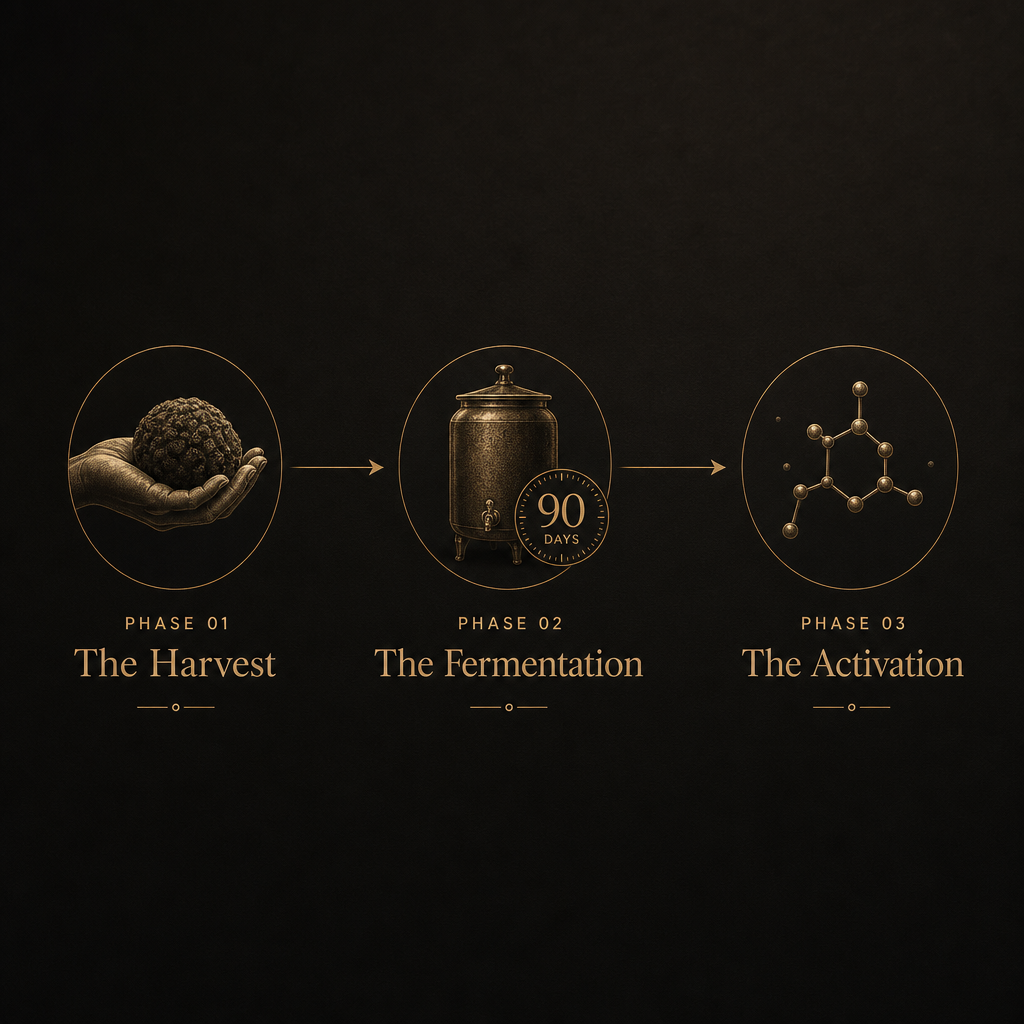
From there, Truffelle's Bio-Fermentation Process takes over, a three-phase method developed in partnership with biochemical engineer Raniya M. Bodoci.
Phase 01: The Harvest. Truffles are hand-foraged at peak maturity from the ancient meteor crater soil, selected for biological richness rather than aesthetic appearance. Harvesting at this precise point ensures the starting material carries maximum bioactive density.
Phase 02: The Fermentation. The truffles undergo a 90-day biological breakdown. This is not a simple extraction. Over 90 days, the fermentation process generates new bioactive metabolites that do not exist in the raw truffle. More critically, it progressively reduces the molecular weight of complex truffle compounds, driving them below the 500 Dalton threshold that the skin's barrier presents as the molecular gateway to the dermis.
Phase 03: The Activation. The bio-concentrate reaches maximum cellular compatibility. At this point, it is formulated into Truffelle's final products. Every batch is poured within 72 hours of fermentation completion to preserve batch-fresh potency. Small seasonal batches are not a marketing narrative. They are a quality control requirement.
This three-phase process is the foundation of what Truffelle calls The Master Key, the proprietary delivery system built into every formulation. The Master Key operates across three dimensions:
- Barrier Fortification: Lipid matrix restoration and ceramide support to reduce transepidermal water loss, rebuilding the structural integrity of the skin barrier from below rather than coating it from above.
- Microbiome Harmony: Prebiotic peptides that restore the skin's bacterial equilibrium. The skin microbiome in women over 50 is often disrupted by years of harsh active use and the hormonal changes of menopause. Rebalancing it is a precondition for sustained skin health.
- Dermal Delivery: Sub-500 Dalton penetration that carries bioactive truffle metabolites into the dermis where structural repair happens. Collagen synthesis, elastin support, and lipid matrix repair all require actives at this depth.
Eleanor M., a verified Truffelle customer with a history of reactive skin and persistent redness, described the experience of using the Black Diamond Duo as feeling like medicine for her skin barrier. Within two weeks, the redness she had contended with for years began to subside. That kind of result does not come from a surface-level hydrator. It comes from a formulation that is actively restoring the barrier architecture beneath the skin's surface.
The Clinical Evidence
Truffelle's formulations are underpinned by clinical data referenced to research conducted by Phenbiox in collaboration with the University of Bologna, and published findings from the Journal of Modern Human Research (2023). The results across a 42-day human trial are specific and measurable:
- +48% increase in hydration. Not surface dampness, but measured skin hydration across the full barrier depth.
- +35% increase in skin elasticity. Elasticity is a dermis-level property governed by elastin and the structural matrix. A 35% improvement is a structural result, not a cosmetic one.
- +30% increase in collagen production. Collagen synthesis occurs in dermal fibroblasts. It cannot be stimulated by actives that do not reach the dermis. This figure is only possible because the bio-fermented peptides are getting below the 500 Dalton threshold.
- 12.8% reduction in wrinkle depth. Measured over 42 days via the same 42-day human trial.
- +0.39mm increase in dermal thickness. Measured via ultrasound imaging, published in the Journal of Modern Human Research (2023). Dermal thickness is the underlying measure of structural skin quality. A 0.39mm increase over 42 days represents genuine dermal rebuilding.
These are not consumer perception surveys. They are clinically measured outcomes from a structured trial. For a woman who has spent years reading ingredient lists and wondering why the mirror does not reflect the investment, these numbers represent a different kind of evidence.
Victoria R., another verified Truffelle customer, replaced a six-step routine with two Truffelle products. The fine lines around her eyes softened, and she described her skin as having a healthy bounce she had not felt since her twenties. The principle behind that experience is one that Truffelle holds firmly: the skin needs fewer, better actives, clinically dosed and delivered where repair happens. More steps built around surface solutions do not compound into structural results.
Understanding Skin Changes After 50 in the Australian Context
For Australian women over 50, the skin challenge is compounded by geography. Australia's UV environment is among the most intense in the world. The Bureau of Meteorology regularly records UV index levels of 11 or above across most of the country's major population centres during summer, a level classified as extreme. Women who have lived their adult lives in Australian conditions carry a UV burden that European and Asian skincare research does not fully account for.
This matters because UV exposure accelerates the collagen degradation and elastin breakdown that already characterise skin ageing after 50. It also means that photosensitising actives carry a proportionally higher risk in the Australian climate. A retinol protocol designed for a Swedish winter is not the same risk profile as the same protocol used by a woman in Brisbane or Perth.
Menupause adds a further layer of complexity. The hormonal changes of perimenopause and menopause directly affect skin at the structural level. Oestrogen plays a role in collagen synthesis, skin hydration, and barrier function. As oestrogen levels decline, so does the skin's ability to maintain those properties autonomously. The result is a compounding challenge: declining collagen production, reduced barrier efficiency, lower baseline hydration, and heightened sensitivity, all occurring simultaneously and in an environment of elevated UV exposure.
Addressing that challenge requires formulations engineered for structural repair, not surface maintenance. It requires actives that reach the dermis. And it requires a clean formulation profile that does not add synthetic hormonal load to a system already managing a significant hormonal shift.
Truffelle's formulations were built with exactly this woman in mind. The Barossa Valley sourcing is not incidental. It reflects a conviction that the earth's rarest actives, harvested at peak potency from ancient Australian soil, produce a bio-concentrate of exceptional quality. The 90-day fermentation is not a production quirk. It is the mechanism that makes dermal delivery possible. The zero-photosensitivity, zero-endocrine-disruptor formulation profile is not a compliance box. It is a direct response to the specific risk environment of Australian women over 50.
Who This Is For and How to Start
Truffelle is not a brand for every skincare buyer. It is a brand for the woman who has already done the mainstream luxury circuit and found it wanting. She has the La Mer, the La Prairie, the Sisley. She has followed the retinol protocols and the vitamin C routines. She is not looking for another beautiful jar. She is looking for a formulation that does what it says it does, backed by evidence she can read and understand, made from ingredients with a traceable provenance, and engineered to actually penetrate and repair rather than hydrate and depart.
The place to start is the Black Diamond Duo, Truffelle's core pairing built around the bio-fermented truffle bio-concentrate. It replaces a multi-step routine, not because simplicity is a marketing idea, but because two products engineered for dermal delivery outperform six products operating at the surface.
For women whose primary concern is wrinkle depth and elasticity, the clinical data is the starting point for the conversation. The 12.8% reduction in wrinkle depth and 35% improvement in elasticity over 42 days are the figures to hold onto. For women whose concern is barrier sensitivity and redness, The Master Key's Barrier Fortification and Microbiome Harmony components are the relevant mechanism.
The Truffelle range is available directly at truffelle.com. Every product carries batch-fresh potency because every batch is poured within 72 hours of fermentation completion. There is no warehouse full of product sitting in transit. There is a short window of peak efficacy and a commitment to delivering within it.
If you have spent freely on luxury skincare and felt let down, the question is not whether to spend more. The question is whether the formulation you are using can actually reach the layer of your skin where the results you want are biologically possible. For most of what is on the market, the honest answer is no. For Truffelle, the mechanism is the answer.
References
- Phenbiox / University of Bologna. Research on truffle extract bioactivity and clinical skin outcomes. Referenced via Truffelle's published clinical data. Available at: truffelle.com/science.
- Journal of Modern Human Research, 2023. Clinical trial data on bio-fermented peptide effects on dermal thickness and collagen production, including ultrasound imaging measurements.
- Australian Industrial Chemicals Introduction Scheme (AICIS). Ongoing regulatory assessment of cosmetic ingredient safety in Australia. Australian Government, Department of Health and Aged Care. Available at: aicis.gov.au.
- Bureau of Meteorology, Australian Government. UV Index observations and forecasts for Australian capital cities. Available at: bom.gov.au.
- Bos, J.D. and Meinardi, M.M.H.M. (2000). The 500 Dalton rule for the skin penetration of chemical compounds and drugs. Experimental Dermatology, 9(3), pp.165-169.